

Home Remedies
Herbal – Holistic – natural
Natural Herbal Home Remedies App



Explore New Books
try home remedies from our collection
Cardiovascular Support
Hibiscus, hawthorn, and lemon balm are prepared as a warm herbal tea for healthy blood pressure support. The cup stays clear, aromatic, and strained before serving.
Instructions
- Place 1 teaspoon hibiscus, 1 teaspoon hawthorn, and 1 teaspoon lemon balm in a covered heatproof mug, heatproof glass jar, or teapot, and heat 1 cup water for the next step.
- Pour freshly boiled water over the herbs, cover, and steep until fragrant.
- Strain well and drink warm, keeping the blend uniform so you learn what works for you.
What you need: You’ll need hibiscus, hawthorn, and lemon balm, hot water, a lidded heatproof mug, heatproof glass jar, or teapot, and a strainer.
When to use: Choose this tea as a short hot steep for healthy blood pressure support.
Storage tips: Let it cool before refrigerating it in a sealed glass jar, and do not keep it when freshness starts to fade. Best within 24 hours.
About this tea: Hibiscus brings tart red color and fruity acidity, hawthorn adds tart berry-and-leaf character, and lemon balm contributes soft lemon-mint leaf aroma. The finished cup should carry hibiscus, hawthorn, and lemon balm with clear color, fresh aroma, and a clean strain.
This hot tea brings turmeric and green tea into a clear brewed cup for cholesterol balance support. The herbs are removed after steeping.
Instructions
- Place 1 teaspoon turmeric and 1 teaspoon green tea in a covered heatproof mug, heatproof glass jar, or teapot, and heat 1 cup water for the next step.
- Pour in hot water just off the boil and steep for 10 to 15 minutes, until the liquid is fragrant and well colored.
- Strain and drink warm, or cool the extra for later.
What you need: You’ll need turmeric and green tea, hot water, a lidded heatproof mug, heatproof glass jar, or teapot, and a strainer.
When to use: Use this warm, strained tea for cholesterol balance support instead of a syrup, capsule, or salve.
Storage tips: Let it cool before refrigerating it in a sealed glass jar, and do not keep it when freshness starts to fade. Best within 24 hours.
About this tea: Turmeric and green tea combine earthy golden rhizome bitterness with grassy tea leaf bitterness. The cup is finished well when turmeric and green tea leave a clean aroma and no loose herbs in the liquid.
This tincture brings hawthorn and rosemary into a concentrated form that is easy to store for measured use. It carries an earthier herbal note, so each serving stays easy to measure.
Instructions
- Add 2 tablespoons hawthorn and 2 tablespoons rosemary to a clean 8-ounce glass jar with a tight-fitting lid; keep 6 tablespoons vegetable glycerin and 2 tablespoons water nearby for covering in the next step.
- Cover with a mix of vegetable glycerin and warm water so everything stays submerged, then cap tightly.
- Let the tincture steep in a dark cabinet for 2 to 4 weeks, shake it daily, then strain into a small amber glass dropper bottle or labeled glass bottle.
What you need: You’ll need hawthorn and rosemary, vegetable glycerin mixed with water, a clean 8-ounce glass jar with a tight-fitting lid, a strainer or cloth, and a small amber glass dropper bottle or labeled glass bottle.
When to use: Prepare this tincture ahead for circulation support, then bottle the strained liquid.
Storage tips: Store it in a dark, cool spot with the lid secure and the dropper clean so the bottle stays in better shape over time. Generally best within 1 to 2 years.
About this tincture: This tincture links hawthorn’s tart berry-and-leaf character with rosemary’s piney aromatic leaf quality in the finished preparation. The bottle should hold a clear extract with no floating herb pieces from hawthorn and rosemary.
Detox & Elimination Support
Milk thistle, dandelion root, and cleavers are combined as a dry blend for liver detox support. The herbs are mixed first, then measured into the final preparation later.
Instructions
- Combine 1 tablespoon milk thistle, 1 tablespoon dandelion root, and 1 tablespoon cleavers in a clean, dry mixing bowl or wide-mouth glass jar, crushing or whisking as needed so the mixture is evenly distributed.
- Stir or shake until the herbs are evenly mixed, then transfer it to a labeled airtight jar or food-safe storage container.
- Keep the container tightly closed and spoon out modest portions as needed.
What you need: You’ll need milk thistle, dandelion root, and cleavers, a clean, dry mixing bowl or wide-mouth glass jar, a spoon or small whisk, and a labeled airtight jar or food-safe storage container for storage.
When to use: Prepare this blend for liver detox support before liquid, oil, capsules, or another base is added.
Storage tips: Keep the blend in an airtight jar or food-safe storage container in a cool, dry place away from heat, light, and moisture, and replace it if the smell or look changes or if moisture gets in. Generally best within 6 to 12 months.
About this blend: Milk thistle brings nutty seed character, dandelion root adds roasted bitter root character, and cleavers contributes fresh green herbaceous character. The dry mixture should show even color and texture so milk thistle, dandelion root, and cleavers stay balanced in each portion.
This tea combines cleavers and nettle in a fresh hot steep. It keeps the herbs in a light brewed form for lymphatic drainage support.
Instructions
- Bring 1 cup hot water to a near-boil and pour it over 1 teaspoon cleavers and 1 teaspoon nettle in a covered heatproof mug or heatproof glass jar.
- Cover and steep for about 10 minutes so the flavor develops fully.
- Strain, drink as-is or with a little honey, and refrigerate leftovers for up to 3 days.
What you need: You’ll need cleavers and nettle, hot water, a lidded heatproof mug, heatproof glass jar, or teapot, and a strainer nearby.
When to use: For lymphatic drainage support, use this tea as a fresh, strained cup.
Storage tips: After it cools, refrigerate leftovers in a clean glass jar with a tight-fitting lid and throw them out if they stop smelling or looking fresh. Best within 24 hours.
About this tea: Cleavers brings fresh green herbaceous character, while nettle adds green mineral leaf character. The finished cup should carry cleavers and nettle with clear color, fresh aroma, and a clean strain.
This loose blend gathers milk thistle, dandelion root, and nettle and can be measured as needed. It offers a green herbal note and an earthy depth in a blend kept dry for measured use.
Instructions
- Combine 1 tablespoon milk thistle, 1 tablespoon dandelion root, and 1 tablespoon nettle in a clean, dry mixing bowl or wide-mouth glass jar, crushing or whisking as needed so the mixture is evenly distributed.
- Stir or shake until the powders look even, then move the blend to a labeled airtight jar or food-safe storage container.
- Seal the jar or container after each use and remove only the amount you plan to use.
What you need: You’ll need milk thistle, dandelion root, and nettle, a clean, dry mixing bowl or wide-mouth glass jar, a spoon or small whisk, and a labeled airtight jar or food-safe storage container for storage.
When to use: Choose this blend as the initial dry step for skin detox support.
Storage tips: Keep the blend in an airtight jar or food-safe storage container in a cool, dry place away from heat, light, and moisture, and replace it if the smell or look changes or if moisture gets in. Generally best within 6 to 12 months.
About this blend: Milk thistle, dandelion root, and nettle are represented through firm, slightly bitter seed quality, roasted root bitterness, and green mineral leaf character. The blend is finished when milk thistle, dandelion root, and nettle are evenly distributed with no heavy pockets of any single herb.
Digestive Health
Peppermint, ginger, and fennel are prepared as a warm herbal tea for indigestion support. The cup stays clear, aromatic, and strained before serving.
Instructions
- Combine 1 teaspoon peppermint and 1 teaspoon ginger with 1 cup water in a small pot and bring it to a low simmer; keep 1 teaspoon fennel nearby for the later addition.
- Simmer, covered, for 10 to 15 minutes, until the liquid smells strong, then add fennel and turn off the heat.
- Steep for 5 minutes, then strain into a mug, and sip warm.
What you need: You’ll need peppermint, ginger, and fennel, water, a small pot with a lid, and a strainer.
When to use: Use this warm, strained tea for indigestion support instead of a syrup, capsule, or salve.
Storage tips: Keep extras chilled in a covered glass jar with a tight-fitting lid after cooling and discard them at the earliest sign that the batch is no longer fresh. Best within 24 hours.
About this tea: Peppermint brings cool mint aroma, ginger adds warming rhizome pungency, and fennel contributes sweet anise seed aroma. The finished cup should carry peppermint, ginger, and fennel with clear color, fresh aroma, and a clean strain.
Fennel, peppermint, and orange peel make a tea with fennel bringing sweet aromatic seed flavor and peppermint adding cool mint leaf aromatics. The cup leans toward a clear minty lift and a bright citrus note, so it tastes good warm and still holds up after cooling.
Instructions
- Place 1 teaspoon fennel, 1 teaspoon peppermint, and 1 teaspoon orange peel in a covered heatproof mug, heatproof glass jar, or teapot, and heat 1 cup water for the next step.
- Pour in hot water just off the boil and steep for 10 to 15 minutes, until the liquid is fragrant and well colored.
- Strain and drink warm, or cool the extra for later.
What you need: You’ll need fennel, peppermint, and orange peel, hot water, a lidded heatproof mug, heatproof glass jar, or teapot, and a strainer.
When to use: For bloating support, use this tea as a fresh, strained cup.
Storage tips: After cooling, store leftovers in the refrigerator in a sealed glass jar and replace them if the batch changes in smell, taste, or appearance. Best within 24 hours.
About this tea: Fennel brings sweet anise seed aroma, peppermint adds cool mint aroma, and orange peel contributes sweet citrus peel aroma. The finished cup should carry fennel, peppermint, and orange peel with clear color, fresh aroma, and a clean strain.
This tea combines ginger, peppermint, and lemon in a fresh hot steep. It keeps the herbs in a light brewed form for nausea support.
Instructions
- Place 1 teaspoon ginger, 1 teaspoon peppermint, and 1 teaspoon lemon in a covered heatproof mug, heatproof glass jar, or teapot, and heat 1 cup water for the next step.
- Pour hot water over the herbs and steep for about 8 to 10 minutes.
- Strain and drink warm; squeeze in fresh lemon at the end for extra brightness if desired.
What you need: You’ll need ginger, peppermint, and lemon, hot water, a lidded heatproof mug, heatproof glass jar, or teapot, and a strainer.
When to use: For nausea support, use this tea as a fresh, strained cup.
Storage tips: Store any cooled extra in a clean glass jar with a tight-fitting lid in the refrigerator and make a fresh batch if the aroma, taste, or look shifts. Best within 24 hours.
About this tea: Ginger brings warming rhizome pungency, peppermint adds cool mint aroma, and lemon contributes bright citrus acidity. The finished cup should carry ginger, peppermint, and lemon with clear color, fresh aroma, and a clean strain.
Energy & Vitality
This hot tea brings rhodiola and eleuthero into a clear brewed cup for daily energy tonic support. The herbs are removed after steeping.
Instructions
- Place 1 teaspoon rhodiola and 1 teaspoon eleuthero in a covered heatproof mug, heatproof glass jar, or teapot, and heat 1 cup water for the next step.
- Pour near-boiling water over the ingredients and steep until the flavor is developed, then strain.
- Drink the tea warm, or let it cool for later use.
What you need: You’ll need rhodiola and eleuthero, hot water, a lidded heatproof mug, heatproof glass jar, or teapot, and a strainer.
When to use: For daily energy tonic support, use this tea as a fresh, strained cup.
Storage tips: Refrigerate what you do not use right away in a clean glass jar with a tight-fitting lid and discard it if the flavor, smell, or appearance seems off. Best within 24 hours.
About this tea: Rhodiola brings rosy bitter root character, while eleuthero adds recognizable herbal character. The finished cup should carry rhodiola and eleuthero with clear color, fresh aroma, and a clean strain.
In this tea, rhodiola, eleuthero, and maca share a cup with a direct herbal flavor. The cup leans toward an earthy depth, so it can be served warm or cooled without losing its balance.
Instructions
- Place 1 teaspoon rhodiola, 1 teaspoon eleuthero, and 1 teaspoon maca in a covered heatproof mug, heatproof glass jar, or teapot, and heat 1 cup water for the next step.
- Pour in hot water just off the boil and steep until the cup is fragrant and fully colored.
- Strain, drink warm, and chill any extra after it cools.
What you need: You’ll need rhodiola, eleuthero, and maca, hot water, a lidded heatproof mug, heatproof glass jar, or teapot, and a strainer.
When to use: Choose this tea as a short hot steep for chronic fatigue support.
Storage tips: After it cools, keep any extra in a sealed glass jar in the refrigerator and discard it if the smell, taste, or appearance changes. Best within 24 hours.
About this tea: Rhodiola brings rosy bitter root character, eleuthero adds recognizable herbal character, and maca contributes malty root-powder character. The finished cup should carry rhodiola, eleuthero, and maca with clear color, fresh aroma, and a clean strain.
This tea combines rhodiola, eleuthero, and cordyceps in a fresh hot steep. It keeps the herbs in a light brewed form for endurance support.
Instructions
- Place 1 teaspoon rhodiola, 1 teaspoon eleuthero, and 1 teaspoon cordyceps in a covered heatproof mug, heatproof glass jar, or teapot, and heat 1 cup water for the next step.
- Pour in hot water just off the boil and steep for 10 to 15 minutes, until the liquid is aromatic and well infused.
- Strain and serve warm, or chill the extra after it cools.
What you need: You’ll need rhodiola, eleuthero, and cordyceps, hot water, a lidded heatproof mug, heatproof glass jar, or teapot, and a strainer.
When to use: Choose this tea as a short hot steep for endurance support.
Storage tips: Keep extras chilled in a covered glass jar with a tight-fitting lid after cooling and discard them at the earliest sign that the batch is no longer fresh. Best within 24 hours.
About this tea: Rhodiola brings rosy bitter root character, eleuthero adds recognizable herbal character, and cordyceps contributes earthy mushroom character. The finished cup should carry rhodiola, eleuthero, and cordyceps with clear color, fresh aroma, and a clean strain.
Immune & Infection Support
Echinacea, elderberry, and rosehip are prepared as a warm herbal tea for cold prevention support. The cup stays clear, aromatic, and strained before serving.
Instructions
- Bring 1 cup water to a near-boil and pour it over 1 teaspoon echinacea, 1 teaspoon elderberry, and 1 teaspoon rosehip in a covered heatproof mug or heatproof glass jar.
- Steep for 10 to 12 minutes, then strain, pressing the herbs lightly if needed.
- Drink warm, or chill it and sip later; adjust sweetness with honey or lemon only if desired.
What you need: You’ll need echinacea, elderberry, and rosehip, hot water, a lidded heatproof mug, heatproof glass jar, or teapot, and a strainer.
When to use: For cold prevention support, use this tea as a fresh, strained cup.
Storage tips: Any leftover liquid should go into the refrigerator after cooling; make a new batch if it no longer smells, tastes, or looks right. Best within 24 hours.
About this tea: Echinacea brings faintly tingling root-and-flower character, elderberry adds dark berry depth, and rosehip contributes tart rose-fruit brightness. The finished cup should carry echinacea, elderberry, and rosehip with clear color, fresh aroma, and a clean strain.
This hot tea brings elderberry and ginger into a clear brewed cup for common cold support. The herbs are removed after steeping.
Instructions
- Bring 1 cup water to a near-boil and pour it over 1 teaspoon elderberry and 1 teaspoon ginger in a covered heatproof mug or heatproof glass jar.
- Steep for 12 to 15 minutes, then strain, pressing the herbs lightly if needed.
- Drink warm, or chill it and sip later; adjust sweetness with honey or lemon only if desired.
What you need: You’ll need elderberry and ginger, hot water, a lidded heatproof mug, heatproof glass jar, or teapot, and a strainer.
When to use: Choose this tea as a short hot steep for common cold support.
Storage tips: After it cools, keep any extra in a sealed glass jar in the refrigerator and discard it if the smell, taste, or appearance changes. Best within 24 hours.
About this tea: Elderberry brings dark berry depth, while ginger adds warming rhizome pungency. The finished cup should carry elderberry and ginger with clear color, fresh aroma, and a clean strain.
This syrup draws lemon and lemon balm into a smooth refrigerated base. The syrup has a bright citrus note, and its texture rounds out the sharper edges.
Instructions
- Combine 1 teaspoon lemon and 1 tablespoon lemon balm with 2 cups water in a small pot and bring it to a low simmer; keep honey or sugar available to sweeten to desired level after straining.
- Keep it at a low simmer for about 20 to 30 minutes, then strain through a fine sieve.
- Cool for 10 to 15 minutes, until warm, then stir in honey or sugar until dissolved, transfer to a clean glass bottle or glass jar with a tight-fitting lid, and refrigerate.
What you need: You’ll need lemon and lemon balm, water, honey or sugar, a saucepan, a strainer, and a clean glass bottle or glass jar with a tight-fitting lid.
When to use: Choose this syrup as a thicker preparation for common cold support.
Storage tips: Store it chilled in a sealed glass bottle or glass jar with a tight-fitting lid, and do not keep using it when the aroma, color, or consistency shifts. Usually best within 1 to 2 weeks.
About this syrup: Lemon sets the main herbal character, and lemon balm adds soft lemon-mint leaf aroma. A finished batch should pour cleanly, smell fresh, and hold the herb character of lemon and lemon balm.
Metabolic & Blood Sugar Balance
This tea brings together cinnamon and gymnema in a warming daily cup. The brew carries warm, spicy notes and settles into a clear spiced finish.
Instructions
- Place 1/2 teaspoon cinnamon and 1 teaspoon gymnema in a covered heatproof mug, heatproof glass jar, or teapot, and heat 1 cup water for the next step.
- Pour just-boiled water over the herbs, cover, and steep for about 10 to 15 minutes.
- Strain well and drink warm; add a squeeze of lemon or a little honey only if desired.
What you need: You’ll need cinnamon and gymnema, hot water, a lidded heatproof mug, heatproof glass jar, or teapot, and a strainer.
When to use: Use this warm, strained tea for blood sugar stability support instead of a syrup, capsule, or salve.
Storage tips: Let it cool before refrigerating it in a sealed glass jar, and do not keep it when freshness starts to fade. Best within 24 hours.
About this tea: Cinnamon brings sweet warming spice, while gymnema adds recognizable herbal character. The finished cup should carry cinnamon and gymnema with clear color, fresh aroma, and a clean strain.
This stored blend gathers green tea, ginger, and dried lemon peel for portion-by-portion use. The blend opens with spiced warmth and a bright citrus note, which makes the mix feel ready before use.
Instructions
- Combine 1 tablespoon green tea, 1 tablespoon ginger, and 1 teaspoon dried lemon peel in a clean, dry mixing bowl or wide-mouth glass jar, crushing or whisking as needed so the mixture is evenly distributed.
- Stir or shake until the mixture looks even, then move it to a labeled airtight jar or food-safe storage container.
- Seal the jar or container after each use and remove only the amount you plan to use.
What you need: You’ll need green tea, ginger, and dried lemon peel, a clean, dry mixing bowl or wide-mouth glass jar, a spoon or small whisk, and a labeled airtight jar or food-safe storage container for storage.
When to use: Choose this blend as the initial dry step for healthy weight support.
Storage tips: Keep the blend in an airtight jar or food-safe storage container in a cool, dry place away from heat, light, and moisture, and replace it if the smell or look changes or if moisture gets in. Generally best within 6 to 12 months.
About this blend: Green tea, ginger, and dried lemon peel create the main profile through grassy leaf astringency, warming rhizome pungency, and bright dried citrus peel aroma. Good blending should leave green tea, ginger, and dried lemon peel evenly distributed and easy to measure later.
Gymnema and peppermint are prepared as a mild daily brew. The cup carries a minty brightness, giving the brew a clean, minty finish that stays easy to sip.
Instructions
- Place 1 teaspoon gymnema and 1 teaspoon peppermint in a covered heatproof mug, heatproof glass jar, or teapot, and heat 1 cup water for the next step.
- Pour just-boiled water over the herbs, cover, and steep for about 10 to 15 minutes.
- Strain well and drink warm; add a squeeze of lemon or a little honey only if desired.
What you need: You’ll need gymnema and peppermint, hot water, a lidded heatproof mug, heatproof glass jar, or teapot, and a strainer.
When to use: Choose this tea as a short hot steep for cravings reduction support.
Storage tips: After it cools, keep any extra in a sealed glass jar in the refrigerator and discard it if the smell, taste, or appearance changes. Best within 24 hours.
About this tea: Gymnema brings recognizable herbal character, while peppermint adds cool mint aroma. The finished cup should carry gymnema and peppermint with clear color, fresh aroma, and a clean strain.
Muscle, Joint & Pain Support
This hot tea brings peppermint, lavender, and rosemary into a clear brewed cup for headache support. The herbs are removed after steeping.
Instructions
- Place 1 teaspoon peppermint, 1 teaspoon lavender, and 1 teaspoon rosemary in a covered heatproof mug, heatproof glass jar, or teapot, and heat 1 cup water for the next step.
- Pour hot water over the herbs and let it steep until aromatic.
- Strain and sip, adjusting steep time next batch for taste.
What you need: You’ll need peppermint, lavender, and rosemary, hot water, a lidded heatproof mug, heatproof glass jar, or teapot, and a strainer.
When to use: Choose this tea as a short hot steep for headache support.
Storage tips: Any leftover liquid should go into the refrigerator after cooling; make a new batch if it no longer smells, tastes, or looks right. Best within 24 hours.
About this tea: Peppermint brings cool mint aroma, lavender adds floral aromatic notes, and rosemary contributes pine-like aromatic edge. The finished cup should carry peppermint, lavender, and rosemary with clear color, fresh aroma, and a clean strain.
This tincture uses a long covered steep with boswellia and turmeric. After straining, the liquid is kept in a measured bottle format.
Instructions
- Add 2 tablespoons boswellia and 2 tablespoons turmeric to a clean 8-ounce glass jar with a tight-fitting lid and cover with 6 tablespoons vegetable glycerin mixed with 2 tablespoons water.
- Cap the jar, keep it in a dark place, and shake it daily while it steeps for 4 to 6 weeks.
- Strain the tincture into a small amber glass dropper bottle or labeled glass bottle.
What you need: You’ll need boswellia and turmeric, vegetable glycerin mixed with water, a clean 8-ounce glass jar with a tight-fitting lid, a strainer or cloth, and a small amber glass dropper bottle or labeled glass bottle.
When to use: Prepare this tincture ahead for back discomfort support, then bottle the strained liquid.
Storage tips: Keep the bottle closed well and out of heat and bright light, and watch for any clear shift in smell, color, or clarity. Generally best within 1 to 2 years.
About this tincture: Boswellia’s resinous frankincense depth forms part of the profile, while turmeric’s earthy golden rhizome bitterness completes the contrast. The bottle should hold a clear extract with no floating herb pieces from boswellia and turmeric.
Arnica, calendula, and St. John’s wort meet in a salve that stays firm in the jar and softens under the fingertips. It offers a light floral edge without feeling overly heavy.
Instructions
- Gently warm 1 tablespoon arnica, 1 tablespoon calendula, and 1 tablespoon St. John’s wort with 1/2 cup carrier oil over low indirect heat for about 1 hour, then strain well; keep 2 tablespoons beeswax nearby for the next step.
- Melt beeswax into the warm infused oil until it thickens slightly.
- Pour into tins and let it set before capping.
What you need: You’ll need arnica, St. John’s wort, and calendula, a carrier oil, beeswax, a low-heat pot or double boiler, a strainer, and clean, dry salve tins or small glass jars.
When to use: Apply this salve as a small topical format for joint stiffness support.
Storage tips: Store it in a clean, tightly closed jar away from heat and direct sun, and discard it if the smell, color, or texture shifts. Generally best within 6 to 12 months.
About this salve: Arnica, calendula, and St. John’s wort combine resinous flower character for topical use, resinous golden flower character, and resinous flowering-top character. The finished salve should set with an even texture and a clean herbal aroma from arnica, calendula, and St. John’s wort.
Nervous System & Stress
This blend keeps the dried herbs together without adding liquid. It is measured out only when preparation begins.
Instructions
- Combine 1 tablespoon lemon balm, 1 tablespoon chamomile, and 1 tablespoon milky oats in a clean, dry mixing bowl or wide-mouth glass jar, crushing or whisking as needed so the mixture is evenly distributed.
- Stir or shake until no pockets of unmixed herbs remain, then transfer it to a labeled airtight jar or food-safe storage container.
- Close the jar after measuring so the blend stays dry between uses.
What you need: You’ll need lemon balm, chamomile, and milky oats, a clean, dry mixing bowl or wide-mouth glass jar, a spoon or small whisk, and a labeled airtight jar or food-safe storage container for storage.
When to use: Prepare this blend for general stress support before liquid, oil, capsules, or another base is added.
Storage tips: Keep the blend in an airtight jar or food-safe storage container in a cool, dry place away from heat, light, and moisture, and replace it if the smell or look changes or if moisture gets in. Generally best within 6 to 12 months.
About this blend: Lemon balm brings soft lemon-mint leaf aroma, chamomile adds apple-like flower aroma and mild bitterness, and milky oats contributes recognizable herbal character. The finished jar should keep lemon balm and chamomile and milky oats visibly mixed throughout the batch.
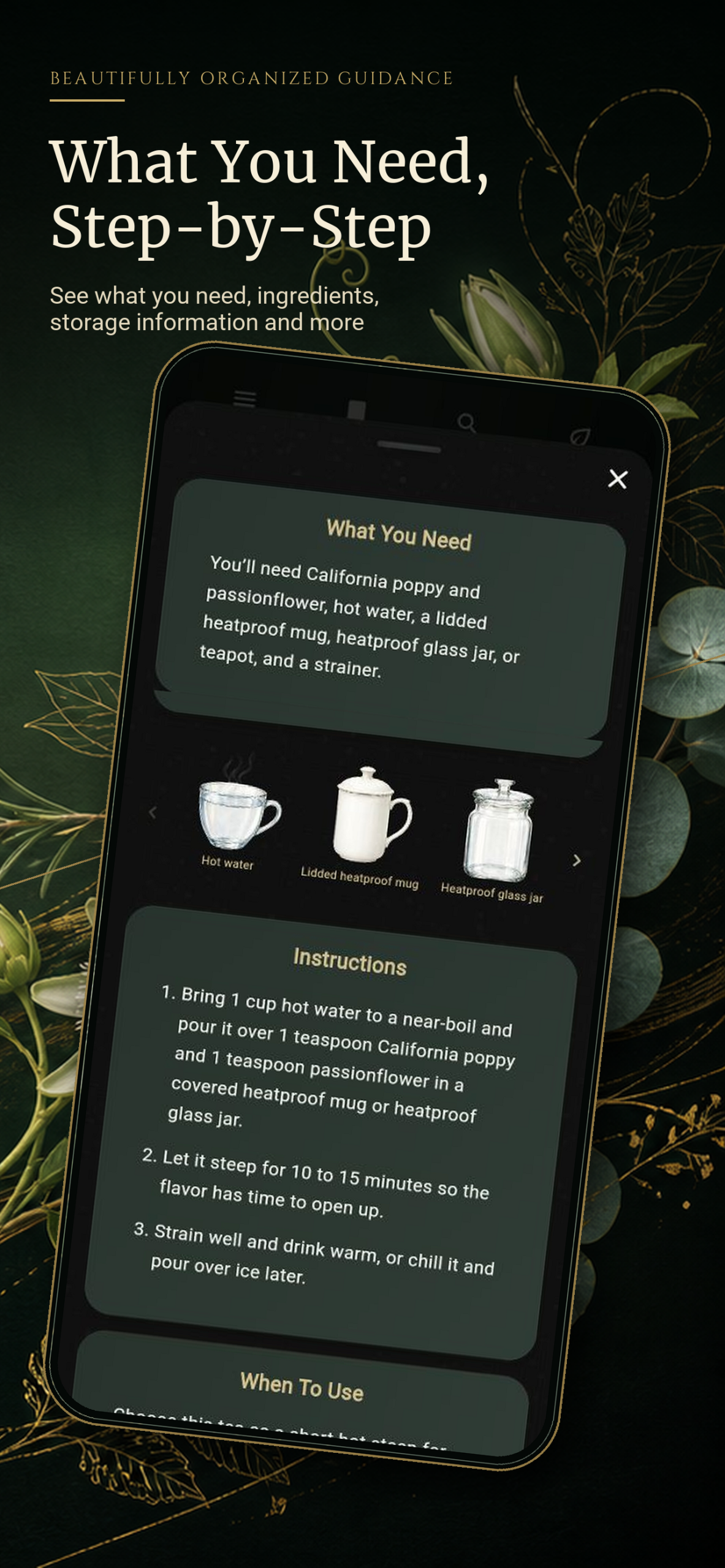
Valerian and passionflower are steeped as a simple hot tea. The preparation is strained before drinking so the cup stays clear.
Instructions
- Bring 1 cup hot water to a near-boil and pour it over 1 teaspoon valerian and 1 teaspoon passionflower in a covered heatproof mug or heatproof glass jar.
- Let it steep for 10 to 15 minutes so the flavor has time to open up.
- Strain well and drink warm, or chill it and pour over ice later.
What you need: You’ll need valerian and passionflower, hot water, a lidded heatproof mug, heatproof glass jar, or teapot, and a strainer.
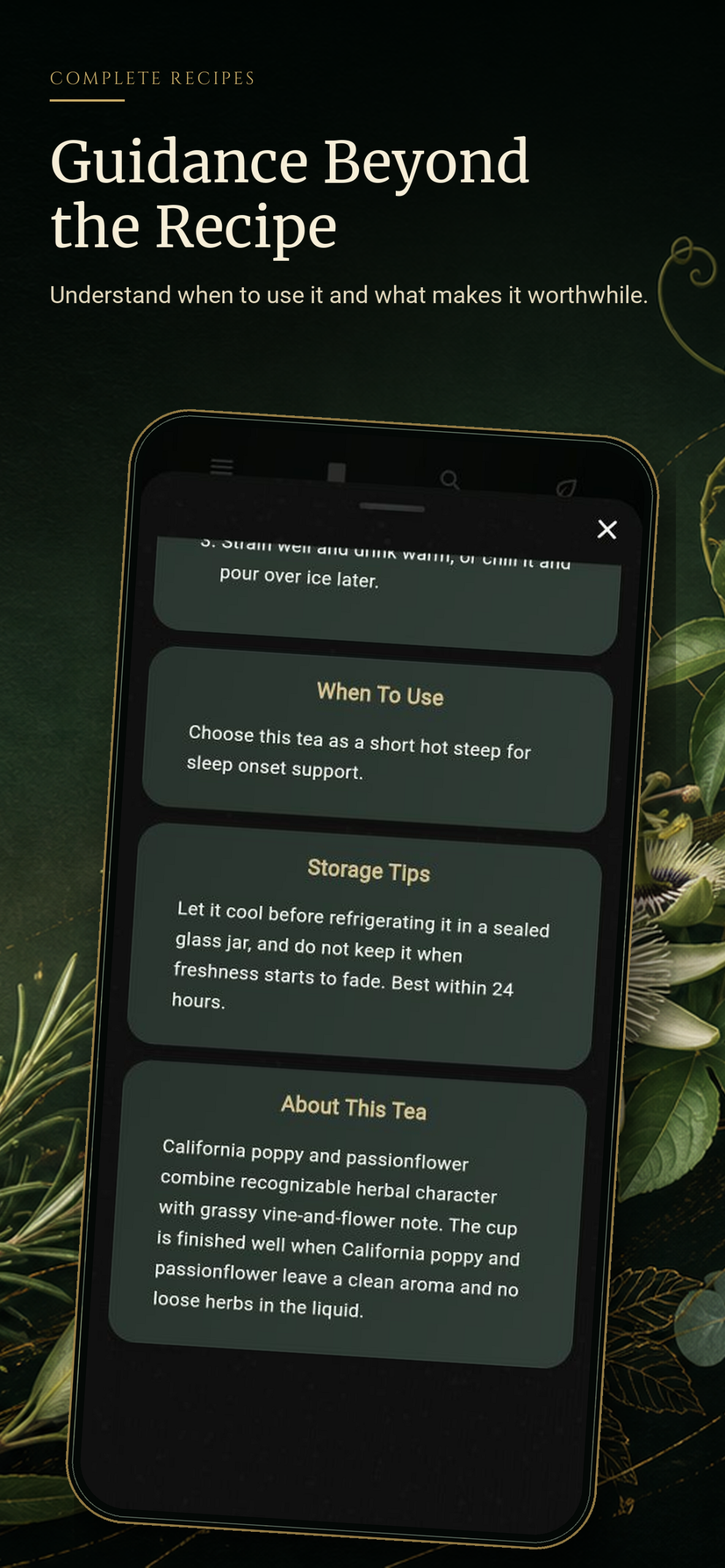
When to use: Choose this tea as a short hot steep for sleep onset support.
Storage tips: Any leftover liquid should go into the refrigerator after cooling; make a new batch if it no longer smells, tastes, or looks right. Best within 24 hours.
About this tea: Valerian brings musky earthy root character, while passionflower adds grassy vine-and-flower note. The finished cup should carry valerian and passionflower with clear color, fresh aroma, and a clean strain.
Rosemary, peppermint, and green tea are used here in a fresh tea format. The result is a warm, strained cup rather than a syrup, capsule, or salve.
Instructions
- Place 1 teaspoon rosemary, 1 teaspoon peppermint, and 1 teaspoon green tea in a covered heatproof mug, heatproof glass jar, or teapot, and heat 1 cup water for the next step.
- Let freshly boiled water cool for a few minutes, pour it over the herbs, cover, and steep for 5 minutes to avoid bitterness.
- Strain and sip, adjusting the steep time next round to match your taste.
What you need: You’ll need rosemary, peppermint, and green tea, hot water, a lidded heatproof mug, heatproof glass jar, or teapot, and a strainer.
When to use: Use this warm, strained tea for focus support instead of a syrup, capsule, or salve.
Storage tips: Store any cooled extra in a clean glass jar with a tight-fitting lid in the refrigerator and make a fresh batch if the aroma, taste, or look shifts. Best within 24 hours.
About this tea: Rosemary brings pine-like aromatic edge, peppermint adds cool mint aroma, and green tea contributes grassy tea leaf bitterness. The finished cup should carry rosemary, peppermint, and green tea with clear color, fresh aroma, and a clean strain.
Respiratory Health
This tea brings together nettle and quercetin in a clean green-herbal cup. The cup carries a green herbal note, giving the brew a clear but gentle finish.
Instructions
- Combine 1 teaspoon quercetin (from onion skin) with 1 cup water in a small pot and bring it to a low simmer; keep 1 teaspoon nettle nearby for the later addition.
- Remove from heat, add nettle, and steep covered until the aroma is fresh.
- Strain well and drink warm, adding a squeeze of lemon if you like.
What you need: You’ll need nettle and quercetin (from onion skin), hot water, a lidded heatproof mug, heatproof glass jar, or teapot, and a strainer.
When to use: For seasonal allergy support, use this tea as a fresh, strained cup.
Storage tips: Store any cooled extra in a clean glass jar with a tight-fitting lid in the refrigerator and make a fresh batch if the aroma, taste, or look shifts. Best within 24 hours.
About this tea: Nettle brings green mineral leaf character, while quercetin adds recognizable herbal character. The finished cup should carry nettle and quercetin (from onion skin) with clear color, fresh aroma, and a clean strain.
Thyme and mullein are used here in a fresh tea format. The result is a warm, strained cup rather than a syrup, capsule, or salve.
Instructions
- Combine 1 teaspoon thyme and 1 teaspoon mullein with 1 cup water in a small pot and bring it to a low simmer.
- Remove from heat, cover, and steep until the tea smells fragrant.
- Strain carefully, pressing lightly, and sweeten if you like before sipping.
What you need: You’ll need thyme and mullein, hot water, a lidded heatproof mug, heatproof glass jar, or teapot, and a strainer.
When to use: Choose this tea as a short hot steep for chest congestion support.
Storage tips: Let it cool before refrigerating it in a sealed glass jar, and do not keep it when freshness starts to fade. Best within 24 hours.
About this tea: Thyme brings garden-herbal pungency, while mullein adds soft leafy base. The finished cup should carry thyme and mullein with clear color, fresh aroma, and a clean strain.
This tea brings together marshmallow root and licorice root in a soft, soothing herbal cup. It drinks with a naturally sweet note and a soft, rounded texture, giving the cup a smooth finish.
Instructions
- Place 1 teaspoon marshmallow root and 1 teaspoon licorice root in a covered heatproof mug, heatproof glass jar, or teapot, and heat 1 cup water for the next step.
- Pour just-boiled water over the herbs, cover, and steep for 10 to 15 minutes.
- Strain well and finish with honey, lemon, or nothing at all, depending on taste.
What you need: You’ll need marshmallow root and licorice root, hot water, a lidded heatproof mug, heatproof glass jar, or teapot, and a strainer.
When to use: For dry cough support, use this tea as a fresh, strained cup.
Storage tips: Keep extras chilled in a covered glass jar with a tight-fitting lid after cooling and discard them at the earliest sign that the batch is no longer fresh. Best within 24 hours.
About this tea: Marshmallow root brings soft, slippery root texture, while licorice root adds naturally sweet root character. The finished cup should carry marshmallow root and licorice root with clear color, fresh aroma, and a clean strain.
Skin Remedies
This salve uses tea tree essential oil in a firmer base, while witch hazel extract stays separate as a topical step before application. The finished salve carries a cooling quality, and the denser base gives it a slower, more protective finish.
Instructions
- Warm 1/2 cup carrier oil with 2 tablespoons beeswax over low heat until the beeswax melts and the base looks smooth; keep 1 drop tea tree essential oil nearby for the later addition; keep witch hazel extract separate for topical use in the later step.
- Remove from heat, let the base cool slightly, then stir in a very small amount of tea tree essential oil.
- Pour into tins and let it set; dab witch hazel extract on the area and let it dry before applying the salve.
What you need: You’ll need witch hazel extract for separate topical use and tea tree essential oil for the salve, a carrier oil, beeswax, a low-heat pot or double boiler, and clean, dry salve tins or small glass jars.
When to use: Apply this salve as a small topical format for acne support.
Storage tips: Heat and direct sun shorten the life of topicals like this, so keep it sealed and set aside any batch that changes in scent, color, or texture. Generally best within 6 to 12 months.
About this salve: Witch hazel extract’s tannic bark-and-leaf extract and tea tree essential oil’s sharp volatile leaf-oil aroma give this salve its main contrast. The cooled salve should set evenly and carry witch hazel extract (separate topical use) and tea tree essential oil in a smooth external-use base.
This salve uses calendula and rosehip in a semi-solid external base. The cooled texture should be smooth enough to apply in a thin layer.
Instructions
- Gently warm 2 tablespoons calendula and 2 tablespoons rosehip with 1/2 cup olive oil over low indirect heat for about 1 hour, then strain well; keep 2 tablespoons beeswax nearby for the next step.
- Melt beeswax into the warm infused oil until the texture looks smooth and even.
- Pour into clean tins or jars and let it set.
What you need: You’ll need calendula and rosehip, olive oil, beeswax, a low-heat pot or double boiler, a strainer, and clean, dry salve tins or small glass jars.
When to use: Apply this salve as a small topical format for dry skin support.
Storage tips: Store it in a clean, tightly closed jar away from heat and direct sun, and discard it if the smell, color, or texture shifts. Generally best within 6 to 12 months.
About this salve: The salve contrasts calendula’s resinous golden flower character with rosehip’s tart rose-fruit brightness. The cooled salve should set evenly and carry calendula and rosehip in a smooth external-use base.
This salve carries calendula, chamomile, and plantain leaf in an oil-and-wax texture. It is poured into tins or small jars after melting.
Instructions
- Gently warm 1 tablespoon calendula, 1 tablespoon chamomile, and 1 tablespoon plantain leaf with 1/2 cup olive oil over low indirect heat for about 1 hour, then strain well; keep 2 tablespoons beeswax nearby for the next step.
- Melt beeswax into the warm infused oil until the texture looks smooth and even.
- Pour into clean tins or jars and let it set.
What you need: You’ll need calendula, chamomile, and plantain leaf, olive oil, beeswax, a low-heat pot or double boiler, a strainer, and clean, dry salve tins or small glass jars.
When to use: Use this salve as a spreadable external preparation for rash support.
Storage tips: Store it in a clean, tightly closed jar away from heat and direct sun, and discard it if the smell, color, or texture shifts. Generally best within 6 to 12 months.
About this salve: Calendula provides resinous golden flower character, chamomile adds apple-like flower aroma and mild bitterness, and plantain leaf brings in green, slightly tannic leaf character. The cooled salve should set evenly and carry calendula, chamomile, and plantain leaf in a smooth external-use base.
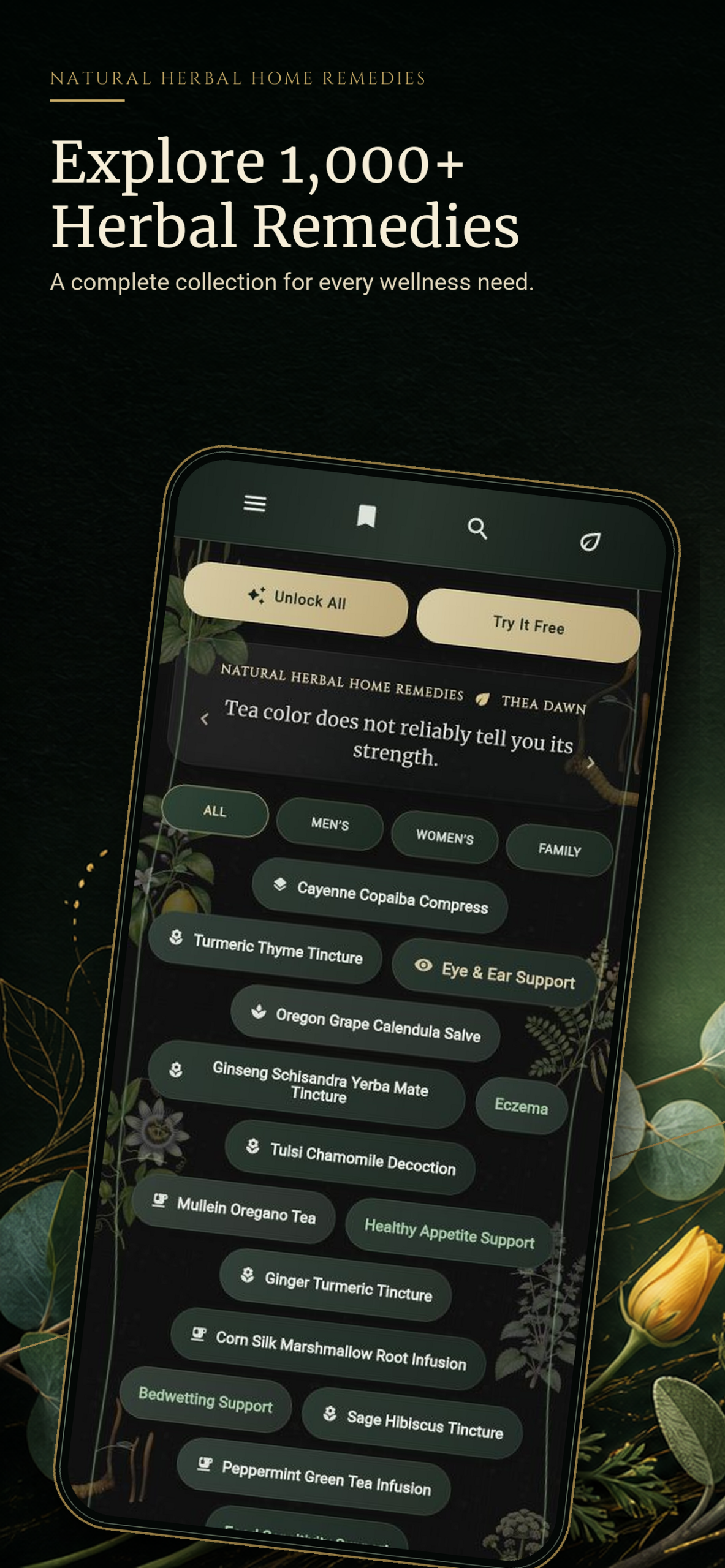
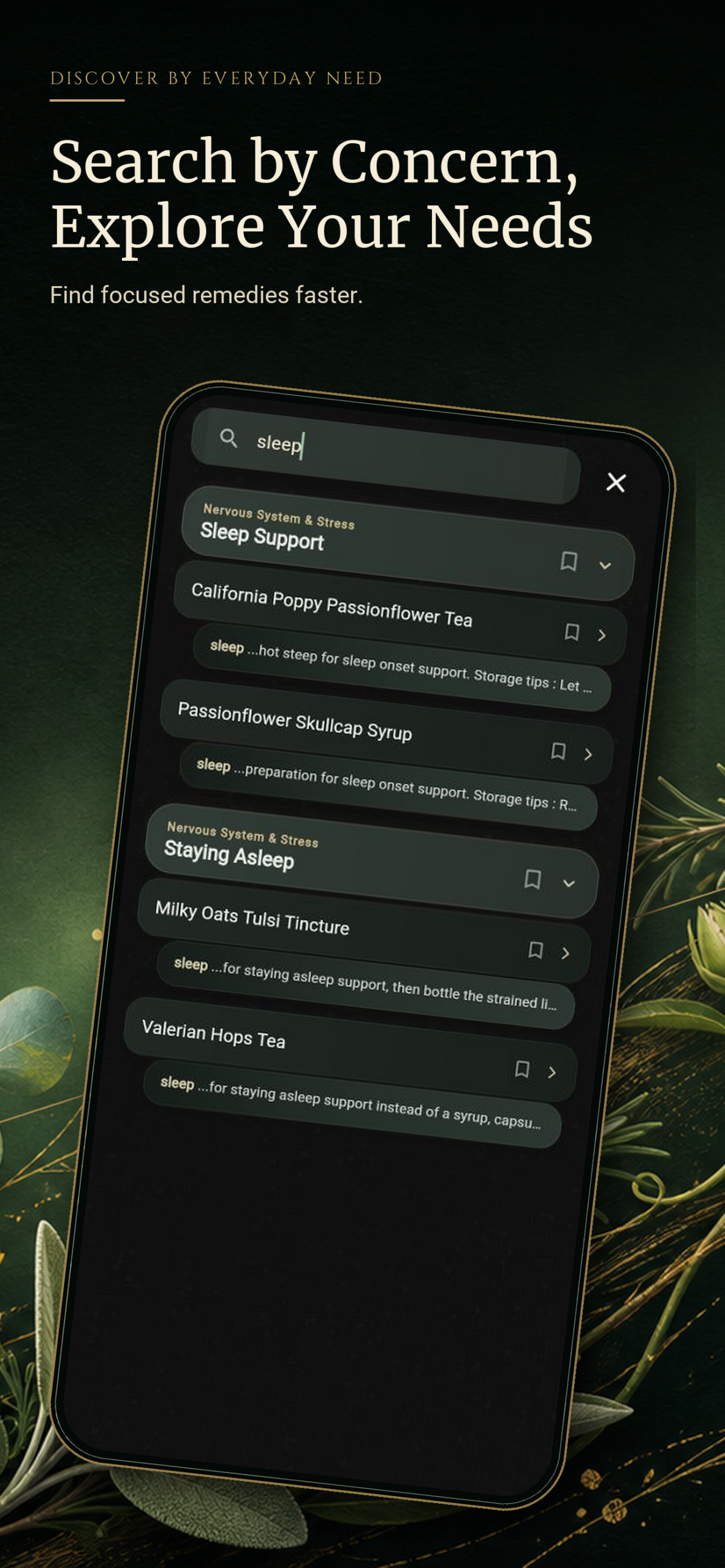
And Many More!
Acid Discomfort
Adrenal Support
Age-Related Vision Support
Arthritis Support
Asthma Support (Non-Emergency)
Bad Breath
Bedwetting Support
Bladder Comfort
Bone Density Support
Brain Fog
Bronchial Irritation
Bruises
Burnout Recovery
Burns (Minor)
Calm Support
Capillary Strength
Chest Tightness
Circulation in Aging
Cold Sores
Cold Season Support
Colon Cleanse
Dry Eyes
Ear Discomfort
Ear Irritation
Eczema
Emotional Overwhelm
Environmental Irritation
Eye Strain
Fertility Support
Fever Support
Fluid Retention
Food Sensitivity Support
Fungal Skin Issues
Gallbladder Support
Gas
General Immune Strengthening
Gum Health
Gut Lining Support
Healthy Appetite Support
Heart Tonic Support
Heavy Cycles
Heavy Metal Support
Hormonal Mood Changes
Hot Flashes
Inflammatory Joint Support
Influenza
Insect Bites
Insulin Sensitivity Support
Irregular Cycles
Kidney Support
Liver Support
Male Vitality
Memory Support
Menopause
Menstrual Cramps
Mental Fatigue
Metabolic Boost Support
Migraines
Minor Cuts
Mobility Support
Mood Balance
Mouth Sores
Muscle Soreness
Nasal Inflammation
Neck Tension
Nervous Restlessness
Occasional Constipation
Occasional Loose Stools
Oily Skin
Pancreatic Support
Parasite Cleanse Support
Perimenopause
Picky Eating
PMS
Post-Illness Recovery
Postpartum Recovery
Prostate Support
Psoriasis Support
Recurrent Infections
Sciatic Nerve Support
Scrapes
Seasonal Cleansing
Sinus Congestion
Smoker Lung Support
Sore Throat
Staying Asleep
Stomach Cramps
Sunburn
Swollen Lymph Nodes
Tendon Support
Tension
Testosterone Support
Tooth & Oral Support
Tooth Discomfort
Urinary Flow Support
UTI Support (Early-Stage, Non-Emergency)
Varicose Vein Support
Warts
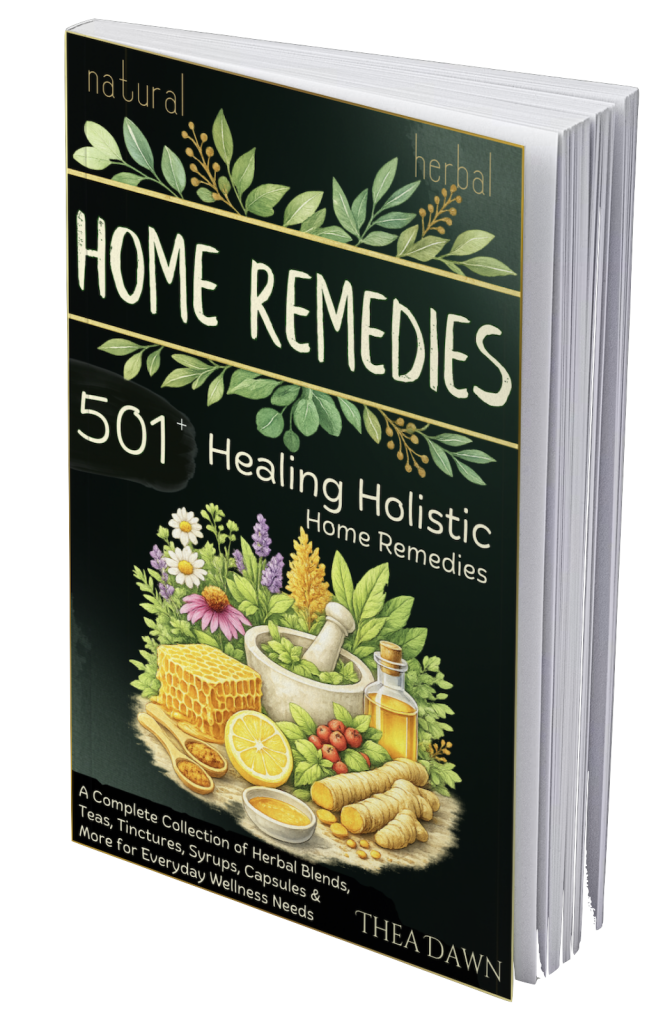
More of Thea Dawn’s remedies can be found in Natural Herbal Home Remedies

Dawn of a Natural Health
Welcome to Thea Dawn: we invite you to be a part of a more natural health in your life and the lives of others.
By cutting down on processed foods and managing health in a more natural way, health starts to improve in a more complete and long-lasting way. It might be more energy, less pain, less chronic issues, it really depends on the person.
We provide free apps and quality books to assist you in your journey.
Our Mission
Thea Dawn is passionately committed to promoting holistic health by blending the timeless wisdom herbal healing traditions with modern, practical solutions. We believe that true wellness stems from a natural and holistic health approach.